Storage & Long-Term Vision: Keeping Your Wine the Right Way
Updated: Aug 11
After clarifying why you collect, the next step is one many collectors underestimate, the one that quietly determines whether every bottle lives up to its potential. Storage isn't simply about keeping wine safe; it's about protecting years of patience, craftsmanship and investment.
In this article, I will show you how to preserve your collection so each bottle can mature as intended.

At my parents' house in Hermitage, we have an underground cellar, the kind of traditional cave space that looks the part. Stone walls, dim light, tucked underground. For years, I stored my own bottles there, thinking I'd found the perfect place.
But it wasn't. The humidity swung hard between seasons: dry and scorching in summer, damp in winter. After three years, I found labels covered in mould and corks that had started leaking from the constant stress of those temperature and humidity shifts. I lost good bottles I'd been keeping for a long time and could not be replaced.
That taught me something simple but crucial: a cellar isn't good because it looks like one. It's good because it protects the wine, consistently, over years.
What Actually Damages a Wine Storage
Temperature stability matters more than the absolute temperature itself. A cellar that holds steady at 16 degrees Celsius is far safer than one that swings between 10 and 22 degrees across the year. Those fluctuations stress the cork, forcing the wine inside to expand and contract. Over time, that micro-movement lets oxygen seep in.
And oxidation is how a beautiful bottle becomes undrinkable.
Humidity needs to sit in a working range too: between 65 and 80% ideally.
Too dry, and corks shrink and crack, letting air in and wine leak out.
Too wet, and some mould grows on labels, cardboard, and eventually on the cork itself.
Light, especially direct or ultraviolet light, degrades wine quickly. That's why good bottles often come in dark glass and good cellars are dark rooms.
And vibration, even subtle but constant from nearby traffic or machinery, keeps the wine in micro-motion, which disturbs the sediment and accelerates chemical changes that should happen slowly over years.
Three Storage Solutions
When I'm advising a client with 50 to 200 bottles, I recommend a quality wine fridge. Especially if they want their collection accessible for entertaining and close to their living space. Look for solid temperature control with a digital display, UV-protected glass, and vibration dampening, like EuroCave or Lehmann Grand Cru.
It won't be cheap, but it's infinitely better than a kitchen cupboard or an uncontrolled spare room, to protect your most beautiful wines
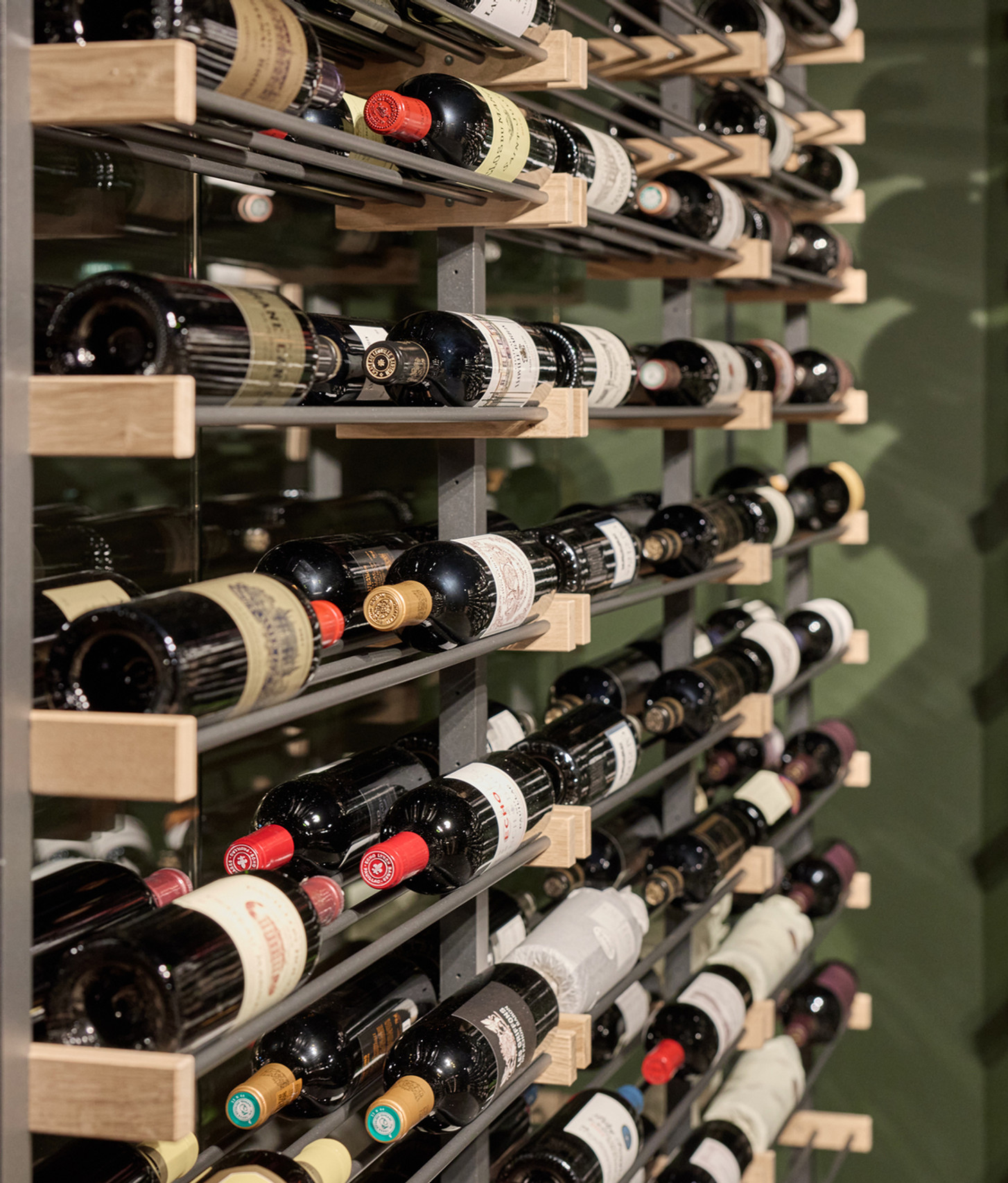
Alternatively, if a client has a spare room or closet that stays naturally cool and dark, we can outfit it properly: lay bottles horizontally on good racks, control temperature passively or with an air-con unit, monitor humidity with a simple gauge. The key is consistency, not perfection for a home cellar and personal consumption.
Once we're past a few hundred bottles, a dedicated home cellar becomes worth considering. This means real insulation, climate control, horizontal racking, and, critically, monitoring systems so we know when something drifts out of range.
Premium wines in original wooden cases should stay in those cases, laid horizontally. The wooden box protects the bottle from vibration and light, and it signals that you're serious about preservation.
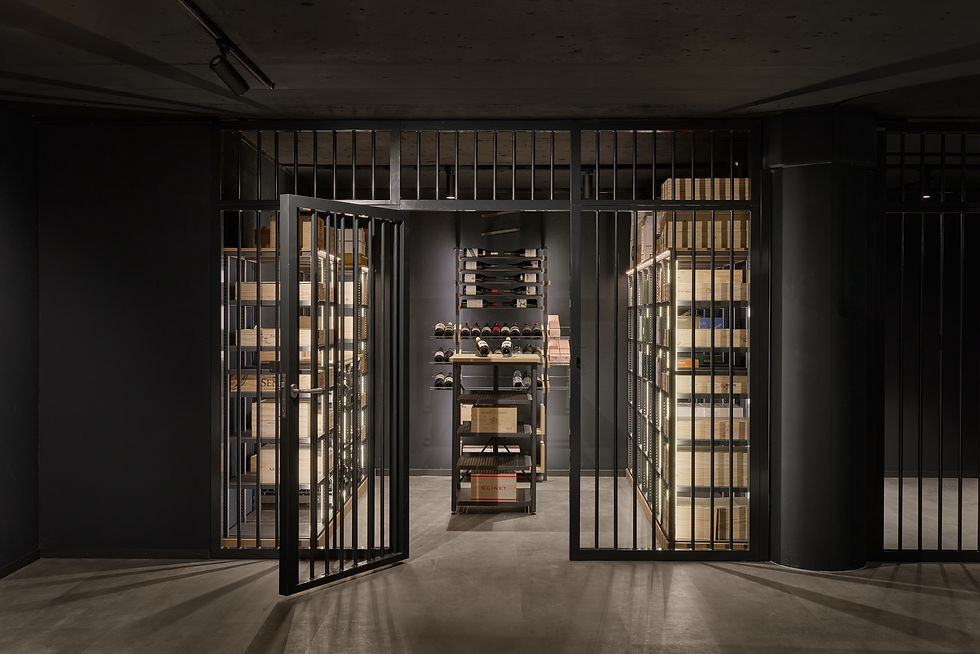
Beyond five hundred bottles, especially when collecting rare or valuable vintages and references, professional climate-controlled storage makes real sense.
Facilities such as wineBANK Zürich maintain stable temperature and humidity, provide security, support inventory management and supply the documentation needed for insurance and provenance.
Some facilities also offer insurance options covering risks such as damage, theft or loss, subject to the provider's terms and valuation requirements.
They may also assist with deliveries and transfers when bottles are bought, sold or traded. For larger collections, these services can reduce the practical burden of ownership while helping protect both the wine's condition and its long-term value.
Storage as Investment Protection
When you're building a collection with the intention to hold and eventually resell or trade bottles, storage becomes something different. It's no longer just about keeping wine drinkable for yourself. It's about protecting an asset. A bottle stored poorly loses value the moment condition is compromised. A crack in the seal, oxidation from temperature swings, mould on the label...
These things don't just damage the wine, they damage your investment.
This is where professional storage facilities make all the difference. When I advise clients holding serious or rare wines, I emphasise that condition guarantees everything. A bottle in perfect condition, original box, pristine label, verified provenance, commands real money. A damaged bottle of the same vintage and producer might sell for half the price, or not sell at all.
If you're serious about wine as an investment vehicle, professional oversight isn't a luxury. It is often essential. It protects your capital and keeps your options open.
Protecting What You've Built:
Security, Insurance, and Authenticity
A collection isn't just wine sitting in a room. Once it has real value, it's an asset. And assets carry risk most collectors don't think about until something goes wrong.
At home, the risks are straightforward but often ignored: theft, fire, flood, and simply no documented proof of how your bottles were stored over the years. That last one matters more than people expect. A bottle that's been sitting in a home cellar for a decade with no records, no temperature logs, no purchase history, no chain of custody, is a harder sell than one that's spent that same decade in a monitored facility with a paper trail. Buyers on the second market aren't just buying the wine, they're buying certainty.
What to ask a professional storage facility
If you're weighing a professional option, these are the questions that actually matter:
What security measures are in place: monitored access, surveillance, insured premises?
Is insurance included, or is it a separate policy you need to arrange?
Do they provide detailed inventory records and storage history for every bottle?
Can they issue documentation you'd need if you sold or transferred bottles later?
What happens to your collection's paper trail if the facility itself changes ownership or closes?
Insurance: what it should actually cover
Wine insurance generally falls into three categories: bundled into a professional facility's fee, a specialist policy you arrange separately, or a rider added to existing home insurance.
Whichever route you take, the policy should cover damage, theft, and loss, and, critically, it should be based on an accurate, documented valuation of your collection, not a rough guess. An undervalued or undocumented collection is often only discovered to be a problem after a claim, when it's too late to fix.
Authenticity and the second marketThis is the part collectors think about least, and it matters most. Counterfeit wine is a real and persistent problem in this industry. Estimates suggest it affects around a 20% of wine in circulation globally, concentrated heavily at the top of the market, in the most sought-after vintages and producers. The wine world's most notorious case, the Rudy Kurniawan affair, showed how even experienced collectors and major auction houses can be fooled, even with rigorous provenance control. The defence is the same whether you're buying or eventually selling: full documentation, from purchase through storage, and physical verification: capsule condition, label integrity, fill level. All records have to be traceable. If you plan to hold a collection for years and sell into the secondary market eventually, that paper trail isn't paperwork for its own sake. It's what determines whether your bottles sell at full value, at a discount, or not at all. |
Bringing It Together
Storage isn't just logistics or infrastructure. It's the foundation that lets your collection do what you bought it for. Whether that's opening a bottle with friends next month or holding something rare for years, knowing it's well protected.
The right storage solution depends entirely on what you're building. A small personal collection of everyday wines doesn't need the same setup as a serious investment portfolio. And your needs will shift over time as your collection grows or your priorities change.
What matters is thinking about it deliberately. Understanding what damages wine, matching your storage to your collection's actual size and value, and knowing when you've outgrown what you can manage at home.
That clarity is what separates a collection that thrives from one that slowly deteriorates without you noticing.
If you're unsure where to start, or want to assess your current setup, I'm here to help. Reach out with any questions — whether it's about storage facilities, improving your home cellar, or understanding what your collection actually needs.
This is exactly where I can help, supporting you in building a collection that's not just valuable, but genuinely yours: sourced with care, stored properly, and built for the long term.
Together, we figure out your why, and then we build a strategy, based on sourcing, storage, and timing, that makes sense for your collection.
I adapt my advisory services to each client. I don't follow a technical sheet. Every single one of my members receives very personalised consulting, all my attention, and I make sure your wines are selected as precisely and carefully as I would do for my own collection.
I adapt my advisory services to each client. I don't follow a technical sheet. Every single one of my members receives very personalised consulting, all my attention, and I make sure your wines are selected as precisely and carefully as I would do for my own collection.
Contact me to begin a confidential conversation about your collection, or subscribe to receive the next article in the series.
Want to explore the world of fine wine with genuine expertise?
At Paroles de Vins, I offer private wine consulting, curated tastings, and exclusive wine experiences for collectors, investors, and hospitality professionals who demand more than a label. → Visit parolesdevins.com to discover our services → Follow @parolesdevins on Instagram for field dispatches from the world's great wine regions → Contact: info@parolesdevins.com |

About the Author
Tony Lécuroux MS
Tony Lécuroux is a Master Sommelier, one of fewer than 300 in the world to hold this distinction, and the 2nd Best Sommelier of Switzerland 2025.
I am the founder of Paroles de Vins, a wine advisory & Wine Concierge company, also creating events based in Switzerland.
I am also a certified lecturer of Wine Education Switzerland, delivering ISG certification programmes across the country.
Having spent a decade working in Michelin-starred restaurants across England and Switzerland, I now work with private clients, estates, and hospitality groups across Europe and beyond.
I grew up near Hermitage in the Northern Rhône Valley, a place that continues to shape my understanding of what wine, at its best, can be.
This article reflects Tony's personal vision and field experience, and does not represent the position of any commercial partner or institution.
The other articles in this series walk you through the practical mechanics: where to source with confidence, how to store properly, how to house your collection as it grows. But none of that matters until you've answered this question first.
So ask yourself: am I building for pleasure, for legacy, for investment, or some mix of all three? Once you know, everything else becomes clearer.
Other articles of the Series
Why You Collect: Already published
Storage & Long-Term Vision: This article
Where to Buy: To be published
Wine as an Investment: To be published
Revisiting Your Strategy: To be published


Comments