
THE REBIRTH OF NEUCHÂTEL
- Oct 13, 2025
- 9 min read
Updated: Oct 15, 2025
WHERE CHASSELAS AND PINOT NOIR FIND THEIR TRUEST EXPRESSION

Every time I drive into the Trois-Lacs region, the same question haunts me: Why does no one speak about this place?
These terraced vineyards cling to Jurassic limestone, these southeast-facing slopes catching first light over the lake.
More importantly, those Pinot Noirs and Chasselas that have nothing—absolutely nothing—to envy from the world's most celebrated appellations. Yet Neuchâtel remains Switzerland's whispered secret, known to locals and a handful of initiated collectors, invisible to the wider wine world.
Last week, tasting through three remarkable estates, that frustration transformed into something else: hope.
A new generation is changing the narrative. Not through marketing or ambition, but through the purity of their vision and the undeniable quality in the glass.
See below their story.
Last week, I had the privilege of meeting a dynamic group of producers who are breathing fresh life into these historical terroirs.
From Morgan Meier at Domaine des Landions to Charlène Contesse at Le Clos aux Moines, and Etienne Javet at Javet-Javet, they share a singular obsession: creating wines that speak purely of place, with minimal intervention and maximum respect for their land.
Where previous generations might have focused their efforts in the cellar—manipulating and crafting wines through technique —today's visionaries understand that exceptional wine begins in the vineyard. This philosophical shift marks the renaissance of Neuchâtel.
UNDERSTANDING THE TERROIR OF NEUCHÂTEL
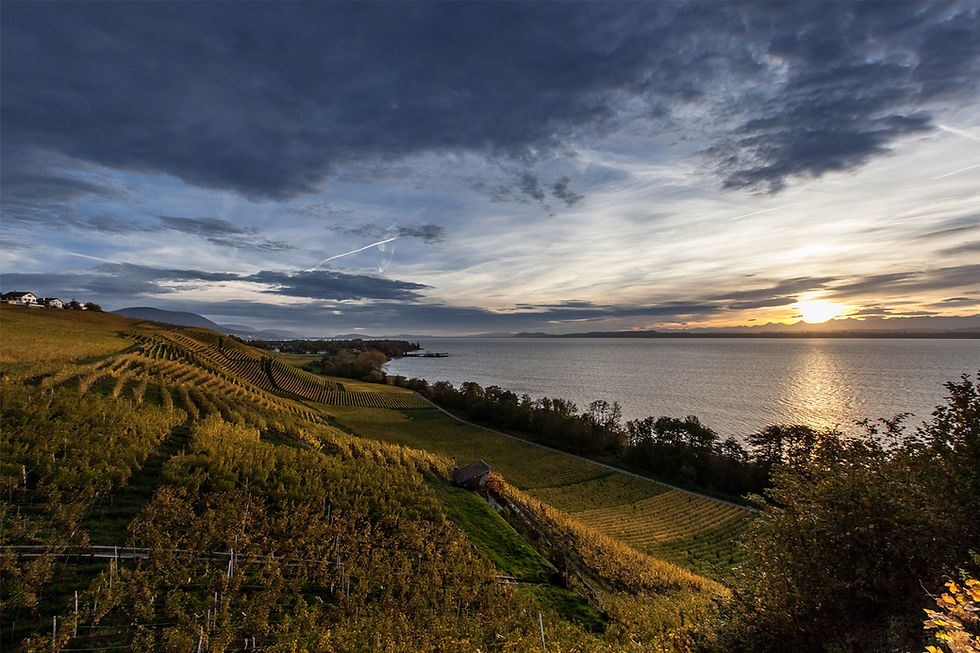
Neuchâtel sits in a privileged geographical position, nestled between the lake that bears its name and the imposing Jura mountains. This creates a narrow ribbon of land stretched along mountain slopes—a landscape as dramatic as it is precise.
The region enjoys a temperate continental climate. Cool winds descending from the Jura peaks are moderated by the lake's thermal mass, creating conditions that are neither scorching nor frigid, but beautifully balanced. Most vineyards face southeast, capturing optimal sun exposure and encouraging long, gentle ripening—essential for developing complexity while maintaining freshness.
THE GRAPE CONVERSATION

The varietal palette here is deceptively simple: Chasselas for whites, Pinot Noir for reds and rosés.
But as any serious vigneron will tell you, simplicity in grape selection allows for profound exploration of terroir and clonal diversity.
The conversation in Neuchâtel right now centres on Pinot Noir clonal selection. While the traditional Cortaillod clone has defined the region historically, it shows increasing vulnerability to climate shifts.
Progressive growers are experimenting with German-Swiss selections—clones with looser bunch structure and better aeration, offering natural resistance to rot.
Yet some find these lack the aromatic concentration they seek, leading them to incorporate Burgundian clones into their massal selections.
This thoughtful blending of clonal material enhances vineyard biodiversity, improves disease resistance, and ultimately adds layers of complexity to the finished wines.. It's viticultural chess played at the highest level.
MEET THE VISIONARIES
Domaine des Landions – Vaumarcus

Morgan Meier's project represents the new generation's ambition realised. After completing his studies and several harvests in Burgundy at the legendary Domaine Rousseau, homesickness drew him back to Neuchâtel with a clear vision: to create an estate with a singular identity, expressing the purest voice of his terroir without stylistic influences.
From day one, Morgan focused on meticulous vineyard work, selecting the finest massal material from his own vines and beyond. His philosophy crystallised into three wines, each sharing a common thread—one identity, one vinification approach, minimal intervention, and the Terroir as the guiding force.
A decade later, he stands alongside regional benchmarks like Domaine des Rochettes (Jacques Tatashciore) and La Maison Carrée (the Perrochet family). Though his estate encompasses 20 hectares, Morgan vinifies only half of it for now, prioritising quality over volume. All parcels are farmed organically, with all bunches included, and almost all wines are aged in 100% French oak from a premium selection.
His vision includes gradually bringing the entire estate production in-house.
New releases are on the horizon—stay tuned.

What makes his wines special: Morgan works with three distinct cuvées of Pinot Noir, each expressing different terroir personalities.
His "Les Cailloutis" from sandy soils is immediately charming and juicy—the perfect introduction to his style. "Les Landions" showcases elegant delicacy reminiscent of Chambolle-Musigny. But it's his "Clos du Château" from pure limestone that truly astonishes—a wine of such power and structure that it stands confidently alongside Pommard Premier Cru or Gevrey-Chambertin.
His Chardonnay "Les Calcaires" is equally impressive, showing what cool-climate viticulture can achieve on limestone terroir. The 2023 vintage, in particular, displays near-perfect equilibrium—rich yet lifted, complex yet precise.
Le Clos aux Moines – Saint-Blaise

After honing her craft at Château de Praz alongside Alain Gerbert, Charlène Contesse made the bold decision to vinify a portion of her family's grapes. She began modestly in the early 2020s with just a single barrel, working nights and weekends while still employed at the château.
Her family's treasure is an exceptional terraced vineyard on the northern shore of Lake Neuchâtel—steep slopes carved into distinctive yellow Jurassic limestone.
Previously, all fruit was sold to a local estate. Charlène inherited two pristine hectares of old vines, impeccably maintained and ready to reveal their potential.
Today, the entire vineyard is cultivated biologically. She employs straw mulching between rows to retain moisture, moderate soil temperature, and encourage biodiversity. Her current focus centres on Chasselas, with three distinct cuvées, plus one Pinot Noir with a parcel-specific bottling planned for future releases.

What makes her wines special:
Charlène's Chasselas display remarkable delicacy paired with structural integrity. They reveal the saline minerality, precision, and crystalline energy of Jurassic limestone without harsh acidity—just pure, expressive tension.
Her range includes a classic "Chasselas Classique" that expresses straightforward purity, an iconic "Chasselas sur Lies" that she's elevated beyond the traditional style, and—most impressively—a barrel-aged "Chasselas Barrique Les Crains" that challenges everything you thought you knew about Chasselas and oak. This wine deserves to be tasted blind alongside serious Chablis Premier Cru. The results will surprise you.
Her Pinot Noir reflects her personality perfectly: refined, discreet, luminous. It's wine that brings people together without demanding attention—sometimes that's the highest compliment.
Domaine Javet-Javet – Vully

Etienne Javet represents the sixth generation of his family to farm vineyards in Vully, but he is the first to bottle his own wine—a distinction that defines everything about his approach.
Since childhood, he dreamed of crafting his own cuvées from the family's grapes. At just 19, while still studying at Changins University, he began vinifying his first lots. His talent was recognised swiftly: Gault et Millau named him "Rookie of the Year" in 2021
Etienne's domaine sits in the small village of Vully, not on Lake Neuchâtel's shores but along its neighbour, Lake Morat (Murtensee), part of the broader Trois-Lacs region.
Here, vineyards are more dispersed than in Neuchâtel proper, offering varied exposures, slopes, and distances from the lake. Soils are predominantly poor molasse with low clay content—ideal conditions for concentrated, terroir-expressive wines.
He farms four hectares biodynamically, working the land primarily himself with help from close family. His hands reveal the intensity of this daily labour, yet his energy never wanes. He speaks about each plot, each vine, with poetic precision—able to discourse for hours on the subtle personality differences between his neighbouring parcels.

What makes his wines special:
What sets Etienne apart is his refusal to think of wine solely in vineyard terms. His philosophy extends into élevage, where he applies the same thoughtful attention to ageing and time. He doesn't follow a fixed recipe or house style. Instead, he selects the right vessel—specific tanks, carefully chosen barrels, for each lot, allowing every "child" to express its unique personality.
This adaptive approach means his wines respond to vintage conditions rather than fighting against them. The cool, precise 2021 is allowed to be crystalline and tense. The warm, generous 2020 and 2022 express their solar character without heaviness. Each vintage reaches its full potential by being exactly what it wants to be.
His range is remarkably diverse: from textural Chasselas "L'Origine" to bone-dry Traminer (a Vully speciality), sharp Pinot Gris, surprising oak-aged Sauvignon Blanc, and three distinct Pinot Noirs. His "Aime Terre" blend is his calling card—the name means "loves earth"—but his two single-parcel wines, "Sur Chamba" and "de Mur", showcase how dramatically terroir can shape the same variety in the same vintage. One offers delicacy, the other demands patience with its structural power.
WHY THIS MATTERS NOW
Standing in these cellars, walking these vineyards, tasting through barrels and bottles with Morgan, Charlène, and Etienne, I realised I wasn't simply discovering new wines. I was witnessing the reclamation of a forgotten voice in the European wine conversation.
Neuchâtel and Trois-Lacs are no longer content to be Switzerland's best-kept secret. These producers aren't interested in mimicking Burgundy or chasing international acclaim. They're focused on something far more compelling: absolute honesty.
In an era of global wine homogenization, where "international style" often means the same techniques producing similar results from Napa to Margaret River, these Swiss vignerons offer something increasingly rare—wines that could come from nowhere else on earth.
The yellow Jurassic limestone of Le Clos aux Moines. The organic-rich slopes of Neuchâtel. The poor molasse soils of Vully. Each speaks with its own accent, its own cadence, its own truth.
The Burgundy Comparison
Let me be direct: several of these wines stand confidently alongside Burgundy's finest.
Morgan's Clos du Château has the structure and ageing potential of serious Pommard or Gevrey-Chambertin.
Charlène's barrel-aged Chasselas deserves consideration next to Chablis Premier Cru.
Etienne's "de Mur" displays the kind of terroir expression and cellar-worthiness that collectors seek in grands crus.
But they're not trying to be Burgundy. They're expressing something uniquely Swiss, uniquely Neuchâtel.
And that's precisely what makes them essential.
You need to keep them on track if you still create your cellar with uniqueness and wines full of integrity!
The Value Proposition
Here's the reality that collectors should understand: you're discovering these producers at a pivotal moment. Morgan has been at this for a decade, but international recognition is just beginning. Charlène started with one barrel in the early 2020s—she's still building her legacy. Etienne was named Rookie of the Year in 2021.
In five years, these wines will be significantly harder to find and notably more expensive. Right now, you have access to world-class terroir-driven wines from passionate producers at prices that reflect their emerging status rather than their actual quality.
If you're interested in finding those wines, I can help you. Just contact me
WHAT I DISCOVERED
Time to taste!

In a complete day, I evaluated more than 40 wines from these three estates—current releases, barrel samples, library bottles, and upcoming vintages. The range was extraordinary: from crystalline Chasselas that tasted of Alpine mineral springs to contemplative Pinot Noirs that revealed new dimensions with each return to the glass.
Some wines transported me immediately. Others demanded time, conversation, food, and reconsideration. The best wines always do.
Wines That Changed My Perspective:
Morgan's 2024 Clos du Château: Even in barrel, this wine displays extraordinary depth. If Les Landions is Chambolle-Musigny, this is Pommard—strict limestone tannins, meaty texture, penetrating acidity. It won't flatter in youth, but patient collectors will be rewarded handsomely by 2035-2040.
Charlène's Barrique Chasselas 2024: I challenge sceptics to taste this blind. She's achieved what most consider impossible—integrating oak with Chasselas in a way that enhances rather than dominates. It needs time to harmonise, but once ready, this wine will stand alongside serious white Burgundy.
Etienne's Pinot Noir "de Mur" 2022: Where his "Sur Chamba" offers immediate charm, "de Mur" is all structure and intensity. This wine leaves a powerful impression. It's almost indestructible—don't open before 2028, but it will reward patience through 2035 and beyond.
The Vintage Story: Tasting through multiple vintages revealed how these producers adapt rather than impose. The cool 2024s show brilliant acidity and ageing potential. The warm 2023s display generosity without losing freshness. The 2022s are concentrated and powerful. Each vintage is allowed to be itself.
EXPERIENCE THESE WINES YOURSELF
I've compiled detailed tasting notes for all 21 wines I evaluated during this visit, organised by producer. Each note includes:
Technical details about vinification and ageing
Vintage-specific context to understand what shaped each wine
Detailed tasting impressions from multiple evaluations
Optimal drinking windows based on structure and evolution
Sophisticated food pairings that honour each wine's character
Cellar recommendations for collectors
These aren't generic tasting notes. They represent hours of careful evaluation and reflect the extraordinary access these producers gave me to their cellars, their barrels, and their stories.
Access the Complete Collection:
→ Domaine des Landions - Complete Tasting Notes (10 wines across multiple vintages)
→ Le Clos aux Moines - Complete Tasting Notes (4 wines including the revelatory Barrique Chasselas)
→ Domaine Javet-Javet - Complete Tasting Notes (7 wines from Chasselas to Pinot Noir)
Each collection is available as a detailed webpage with a coming option to download a beautiful PDF with all those tasting notes and specific information about those estates.
FINAL THOUGHTS
Neuchâtel is no longer a footnote in Swiss wine. Thanks to producers like Morgan, Charlène, and Etienne, it's becoming a conversation that serious collectors can't afford to ignore.
These aren't wines made for critics or competitions. They're wines made for the table, for contemplation, for moments that matter. They're wines that reward attention and patience. They're wines that tell the truth about where they come from.
If you've read this far, you understand that these aren't just wines—they're expressions of a renaissance. And the details matter.
The question isn't whether these wines deserve your attention. The question is whether you'll discover them now, or five years from now, when everyone else has caught on.
About the Author
I am Tony Lécuroux MS.
I have worked as a head sommelier for the past decade. I now want to share my passion for wine with all lovers over here.
I can craft a wine tour, a tasting experience based on your taste, your habits and personal taste. Experience and being a Human being are the most important in the wine industry.
We together make the Wine Alive
Related Reading:


Comments